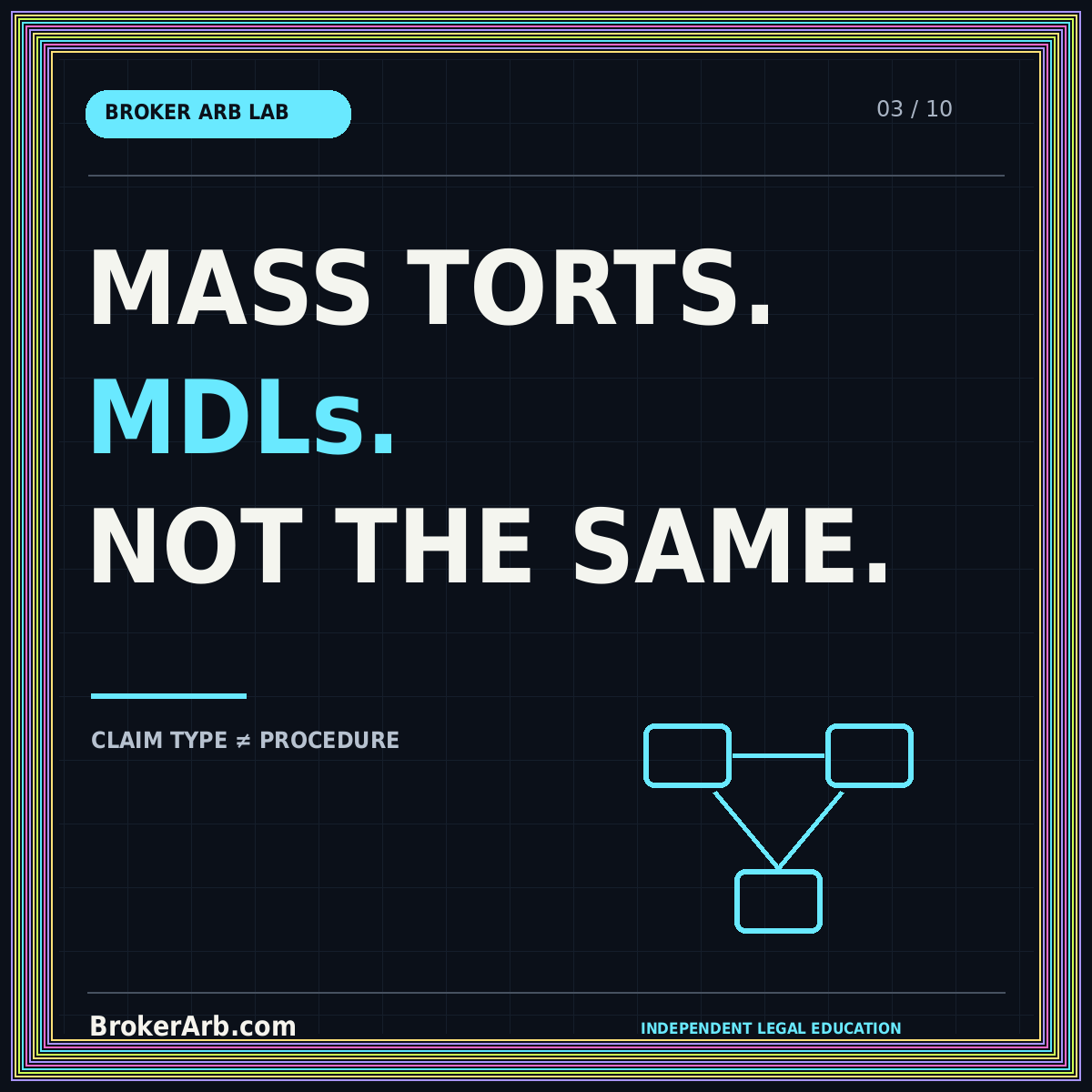
“Mass tort,” “MDL,” and “mass arbitration” often appear near one another in search results, but they answer different questions. One describes a broad kind of litigation involving alleged harm to multiple people. Another describes a federal court coordination mechanism. The third describes the pursuit of multiple individual arbitration demands. Treating them as synonyms can obscure who is involved and what procedure actually applies.
For a plaintiff or referring lawyer, the useful starting point is a map of the matter rather than a ranking of procedures. Identify the underlying allegations, the parties, the existing proceedings, and the documents governing any proposed next step. This article explains the distinctions without recommending a filing strategy.
Mass tort describes a problem involving multiple claimants
A mass-tort discussion usually concerns multiple people alleging injuries connected to a product, event, or course of conduct. The phrase does not, by itself, identify a court, establish a class, or supply a set of arbitration rules. Two people discussing the same product may still have different exposure histories, injuries, records, and legal questions.
As a practical matter, begin with a claimant-specific account before comparing it with a wider group. Which product or event is involved? What is known about the relevant dates? Which records concern this person rather than another claimant? The Mass Torts Broker Arb guide uses the search label as a starting point for these questions, not as a claim that every mass-tort dispute belongs in arbitration.
MDL is a coordination mechanism, not a payout program
The Judicial Panel on Multidistrict Litigation’s explanation of its role describes transferring federal civil actions with common factual questions for coordinated or consolidated pretrial proceedings. The stated aims include reducing duplicated discovery and inconsistent pretrial rulings. That coordination function is different from deciding that every allegation is true or that every person with a similar experience is entitled to compensation.
For a reader encountering an MDL number, the practical task is to identify the actual docket and the documents relevant to their situation. Do not infer that a personal matter has been filed, transferred, accepted by counsel, or resolved merely because a product appears in an MDL discussion. Those are separate questions requiring separate confirmation.
Mass arbitration starts from individual demands
The expression “mass arbitration” is commonly used for the coordinated pursuit of numerous individual arbitration demands. Before drawing conclusions from the label, ask which agreement and provider rules are said to apply and how individual demands are identified. The terminology alone does not establish the governing procedure, the availability of coordination, or the enforceability of an agreement.
A helpful reading method is to separate a proposed organizational approach from the authority for that approach. A firm may describe how it plans to manage a large group of files, but that description is not itself a forum rule. Ask which parts of a proposal concern internal administration and which parts depend on a contractual provision, governing rule, order, or other legal determination.
Why these concepts are not interchangeable with a class action
A representative class proceeding raises a different structural question from coordinating separate cases or separate arbitration demands. It is therefore unhelpful to call every large group of claimants a class. A shared advertisement, a common lawyer, or a similar product history does not answer the procedural question.
For a concrete comparison, imagine several people keeping records about the same device. Their files might share a product name while differing in dates, models, treatment, and alleged harm. That observation tells you why coordinated research could be useful, but it does not determine how claims may proceed. The class-action versus arbitration guide explores the brokerage context and its particular boundaries without treating all collective disputes as one category.
Keep common issues and personal evidence in separate folders
A sensible organizational method uses one folder for broadly relevant public material and another for records concerning the individual. The public folder might contain a notice, a product communication, or an order already obtained from an official proceeding. The individual folder might contain purchase information, treatment records, communications, and a chronology with source references.
Label the status of each item
Distinguish a filed allegation from a finding, a proposed arrangement from an approved one, and a public summary from the underlying document. When a document concerns another claimant, label it accordingly. This prevents a common research error: allowing material that is relevant to the general subject to stand in for evidence about a particular person. Keep missing information visible rather than silently borrowing facts from another file.
Coordination does not answer who represents whom
A coordinated matter can involve many professional roles. The person answering general questions, the lawyer reviewing an individual file, and the lawyer handling a shared procedural issue may not be the same person. Ask who represents the client, what that representation includes, and who is responsible for communicating about individual decisions.
Referring counsel should document the handoff rather than assume that participation in a larger effort resolves it. Which materials were shared with permission? Has the receiving firm accepted an engagement or only agreed to review? Who is checking deadlines while the review is pending? Our law-firm referral guide turns these questions into a communication framework. Coordination should make responsibility clearer, not less visible.
Treat screening requests as requests, not acceptance
A request for product details or medical records may be part of preliminary screening. It does not necessarily establish that a firm has accepted a case or that a person has become a participant in a proceeding. Ask what the requested information is for, who will review it, and how the review decision will be communicated.
Before sending sensitive material, establish an appropriate recipient and secure transfer method. Avoid posting a full treatment history in a public forum simply because others are discussing the same product. Keep a record of what was sent and when. BrokerArb.com does not operate a screening portal or receive confidential case files; its topic pages explain questions to ask rather than providing a mechanism to join litigation.
Evaluate proposed efficiencies without assuming identical outcomes
Shared organization can sound attractive, but a proposal should explain what is actually being shared. Is it document collection, common factual research, communication infrastructure, or a procedural request? Ask how individual differences will be recorded and who will investigate information that does not fit the dominant narrative.
Also ask about the practical limits of the proposed arrangement. How are urgent individual issues escalated? What happens when a file is unsuitable for the proposed route? How are costs explained? A useful answer acknowledges that common preparation and individual analysis can coexist. An unhelpful answer treats a large number of inquiries as proof that every person belongs in the same process or should expect the same result.
Make a one-page map of the participants
Draw a simple map in your notes identifying the client, existing counsel, any firm considering a referral, the relevant product entity, and the proceeding being discussed. Put the source for each connection beside it. Leave a connection unconfirmed when it rests only on a marketing statement or a conversation that still needs clarification.
The map can expose a misunderstanding before it spreads through a large file. For example, a person answering administrative questions may not be the lawyer advising the individual, and a firm researching common issues may not have accepted every inquiry. The point is not to design the litigation structure yourself, but to identify the relationships a professional needs to explain.
Conclusion: name the claim and the procedure separately
A clearer description might say that a person is researching an alleged product injury and wants to know whether an existing coordinated proceeding is relevant. That is more precise than saying “I need mass-tort arbitration” before any agreement, forum, or case has been identified. The extra precision helps a professional determine which questions need attention first.
Use the Mass Tort Broker Arbitration page when arbitration language appears in a product-liability discussion, and the mass-torts and class-action comparison for the broader vocabulary. No group label establishes eligibility, liability, or payment. Obtain case-specific advice promptly and keep personal records, public research, and procedural assumptions clearly separated throughout that conversation.